



There is more to choosing a car lift than comparing capacity, features, or price. Before requesting quotes, confirm that your shop has enough usable ceiling height for the lift and the tallest vehicles you service.
A shop with a 12-foot ceiling may have significantly less usable clearance because of door tracks, HVAC ducts, lighting fixtures, or structural beams. Overlooking these obstacles can lead to installation delays, unexpected costs, or a lift that can’t reach its intended working height.
Whether you’re opening a new repair facility or upgrading an existing bay, planning your lift installation alongside the right shop management software for auto repair shops helps create a more efficient workspace.
Why Ceiling Height Is the First Spec to Confirm Before Buying a Lift
It’s easy to compare lifting capacity, features, and price. But none of that matters if the lift won’t fit your shop. Before you start narrowing down models, make sure your building has enough usable overhead clearance for the lift and the vehicles you plan to service.
What “usable ceiling height” actually means vs. nominal ceiling height
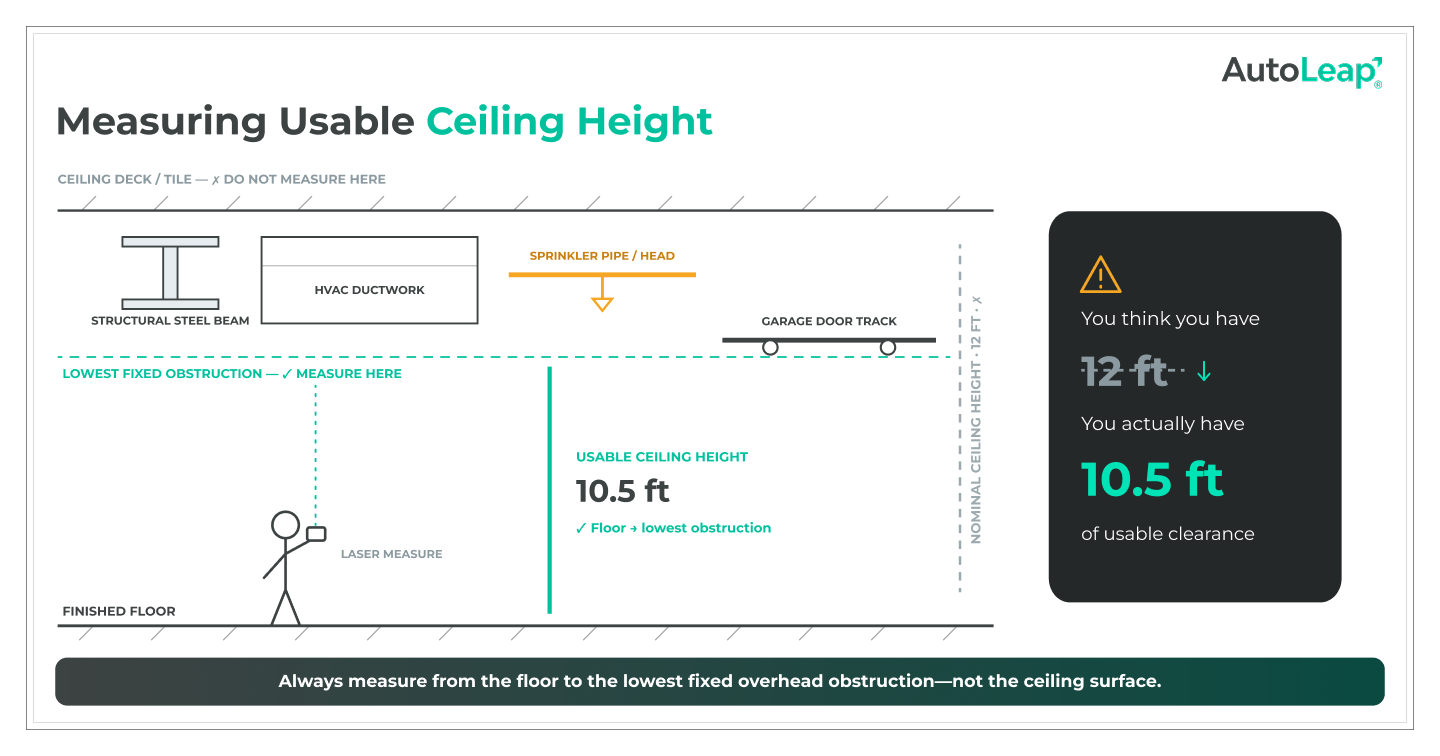
A building listed with a 12-foot ceiling doesn’t automatically give you 12 feet of working space. Usable ceiling height is the distance from the finished floor to the lowest fixed obstruction above the lift bay, not the roof deck or suspended ceiling. Those obstructions often include:
- Overhead garage door tracks
- Steel support beams
- HVAC ductwork
- Sprinkler piping
- Electrical conduit
- Hanging light fixtures
For example, a shop with a nominal 12-foot ceiling may have only 10.5–11 feet of usable clearance once overhead obstructions are considered.
The clearance formula every lift buyer should know
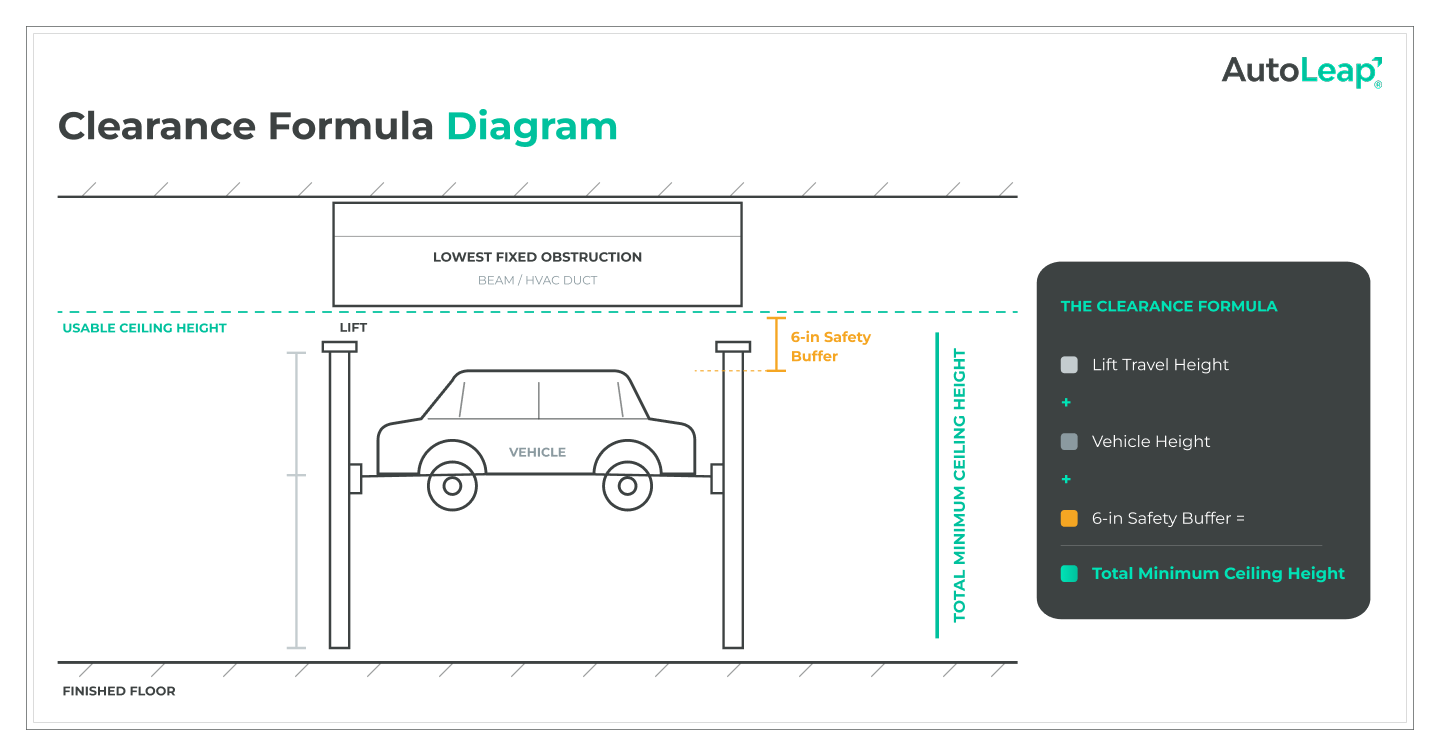
Before requesting quotes, use this simple formula to estimate whether a lift will fit your shop:
Lift travel height + vehicle height + 6-inch safety buffer = Minimum usable ceiling height
For example:
- Lift travel height: 6 ft
- Pickup truck height: 6 ft
- Safety buffer: 6 in
Total minimum usable clearance: 12.5 ft
In this example, the shop would need at least 12.5 feet of usable overhead clearance. Treat this as a planning tool, then confirm the exact dimensions using the manufacturer’s installation manual.
Why the numbers on a lift spec sheet don’t tell the full story
One detail that’s easy to overlook is the difference between lifting height and overall height. Lifting height tells you how high the vehicle can be raised. Overall height tells you how tall the lift itself is once installed. That’s usually the measurement used to determine whether it fits your building.
The Automotive Lift Institute (ALI) recommends identifying overhead obstructions during site planning and following the manufacturer’s installation instructions, while lift manufacturers specify the overall lift height and minimum installation clearances in their manuals.
How to Measure Your Shop Ceiling Height for a Lift Installation
Once you know the lift you’re considering, the next step is measuring your bay correctly. Don’t rely on a single measurement in the center of the shop. Older buildings often have uneven ceilings, sloped floors, or overhead obstructions that change the available clearance.
Step-by-step measurement method
Follow these steps before requesting lift quotes or scheduling an installation:
- Mark the intended lift location. Identify where the lift posts or runways will be installed.
- Measure from the finished floor to the lowest fixed overhead obstruction directly above the center of the planned lift bay. Do not measure to the roof deck or suspended ceiling if another object hangs below it.
- Measure all four corners of the lift footprint in addition to the center.
- Record the lowest measurement. Use the lowest measurement when evaluating lift specifications.
- Compare your measurement with the lift manufacturer’s “overall height” and required overhead clearance, not just the published lifting height.
In older commercial buildings, it’s common to find several inches of variation within a single bay due to sloped floors, beams, or overhead utilities. That’s why one measurement isn’t enough.
What to look for above the bay before you measure
Before you measure, look for anything that extends below the finished ceiling, including:
- Garage door tracks and torsion hardware can reduce usable clearance by several inches near the bay entrance.
- Structural steel or concrete beams, especially in older repair facilities.
- HVAC ducts and exhaust ventilation, which often hang 8–12 inches below the finished ceiling.
- Fire sprinkler piping, conduit, cable trays, and suspended lighting fixtures.
A quick sketch of the bay can save time later. Mark the location of each obstruction so you can confirm that the lift columns, crossbar, and raised vehicle won’t interfere with anything overhead.
When to re-measure after installation planning begins
Your first set of measurements helps narrow your options but don’t stop there.
Once you’ve selected a lift model, compare the manufacturer’s installation drawing with your bay. If the lift location shifts even a few feet, measure again because beams, ductwork, or other overhead obstructions may change the available clearance.
The Automotive Lift Institute (ALI) recommends evaluating overhead clearance as part of the pre-installation site assessment and following the lift manufacturer’s installation instructions. Likewise, manufacturers such as Rotary Lift and BendPak advise comparing your shop’s usable overhead clearance with the lift’s overall height listed in the installation manual, not just its maximum lifting height, before selecting a model.
Taking a few extra measurements now is much easier and less expensive than discovering clearance issues on installation day.
Minimum Ceiling Height Requirements by Lift Type
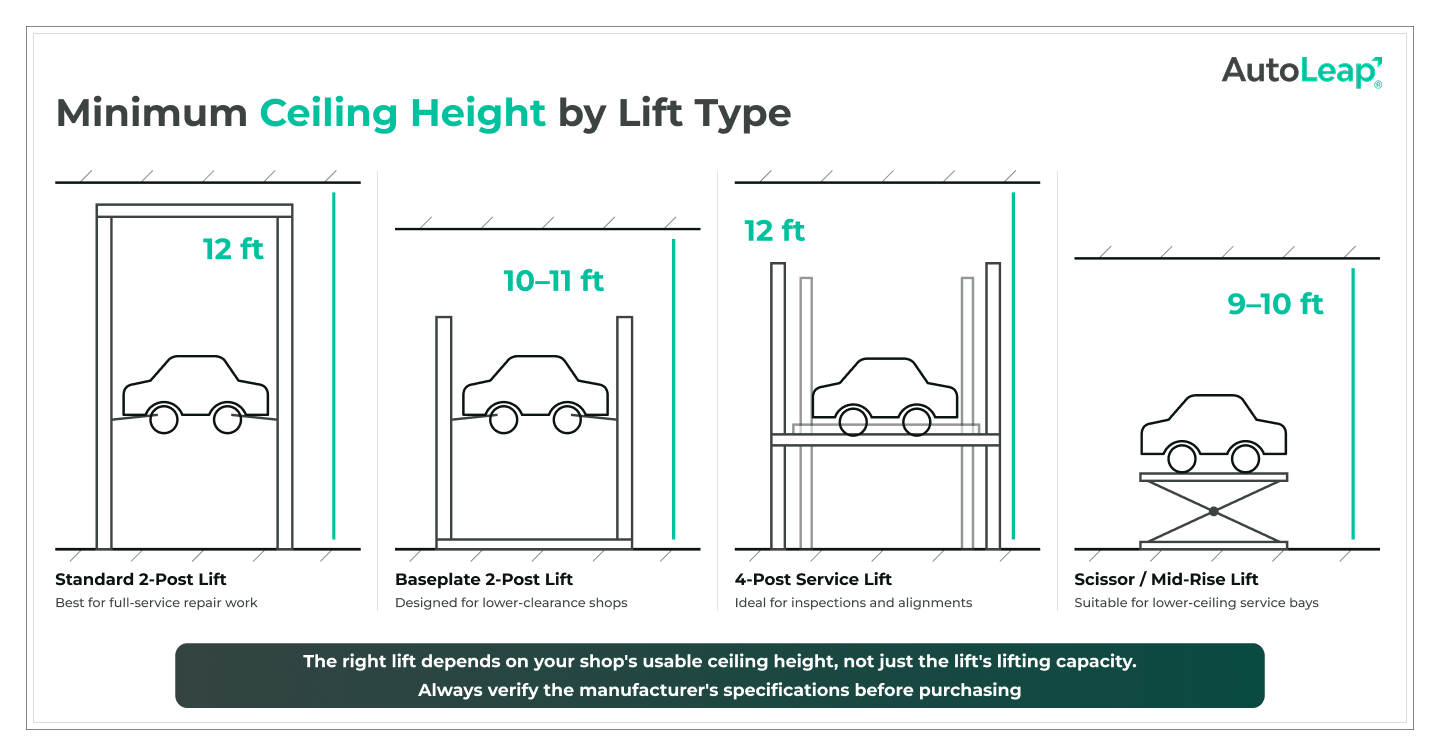
Once you’ve confirmed your shop’s usable ceiling height, the next step is matching it to the right lift. Different lift designs require different amounts of overhead clearance, so the best choice depends on both your building and the vehicles you service.
If you’re wondering how high a ceiling for a car lift you need, the answer depends on the lift design and the tallest vehicles your shop services.
The table below is based on specifications from leading manufacturers such as Rotary Lift, BendPak, Challenger Lifts and Atlas Automotive Equipment. Be sure to check the exact size of your selected model first in the installation guide before ordering.
Lift type | Typical minimum usable ceiling height* | Best suited for | Key consideration |
2-post lift (overhead/crossbar) | 12 ft (3.7 m) | General repair, diagnostics, suspension, transmission work | The overhead crossbar requires additional vertical clearance. |
2-post lift (baseplate/floor-plate) | 10–11 ft (3.0–3.4 m) | Shops with lower ceilings | No overhead crossbar, making it suitable for tighter spaces. |
4-post service lift | 12 ft (3.7 m) | Wheel alignments, inspections, and general service | Vehicle remains on runways, but technicians still need adequate working clearance. |
Scissor, mid-rise, and portable lifts | 9–10 ft (2.7–3.0 m) | Tire, brake, and quick-service work | Lower lifting height limits underbody access compared with full-rise lifts. |
*Planning ranges compiled from current installation manuals published by Rotary Lift, BendPak, Challenger Lifts, and Atlas Automotive Equipment. Always use the manufacturer’s specifications for the exact model being installed.
2-post lifts: standard overhead and baseplate (clear-floor) models
Two-post lifts are the most common choice in professional repair shops because they provide excellent access to the wheels, suspension, and drivetrain. However, not every two-post lift has the same overhead clearance requirements.
A standard overhead 2-post lift is a lift that has an overhead crossbar which joins the two columns together. This crossbar not only keeps the floor free of hydraulic lines and equalization cables between posts, but also supports them. The crossbar is mounted above the vehicle, so there is normally at least 12 feet of space required between the bars and the car.
In contrast, a baseplate 2-post lift uses a reinforced plate across the floor instead of an overhead beam to route the cables. These lifts can be used in buildings that have, say, 10 to 11 feet of clearance. Baseplate 2-post lifts are built without an overhead crossbar, allowing installation in lower-ceiling shops.
If you’re also evaluating bay layout, also consider 2-post car lift space requirements for floor space and post spacing considerations.
4-post lifts: service and storage configurations
Four-post lifts come in two common configurations: service lifts and storage lifts. While they look similar, the amount of overhead clearance you need depends on how you plan to use them.
A service lift is intended to be used for inspecting, aligning and maintenance. Most 4-post service lifts require approximately 12 feet of usable clearance.
A storage or stacking lift is different. Since it supports one vehicle while another is parked underneath, the total height must accommodate:
- The lower vehicle
- The lift runways
- The upper vehicle
- Safe working clearance
As a result, storage applications often require 12 to 14 feet or more, depending on the size of the vehicles being stacked. Larger SUVs, cargo vans, and pickup trucks may require even greater overhead clearance.
Scissor lifts, mid-rise, and portable lifts
If your shop has limited overhead clearance, a scissor or mid-rise lift may be a better fit.
Because these lifts raise the vehicle from underneath rather than using tall support columns, they typically operate comfortably within 9 to 10 feet of usable ceiling height. They’re well-suited for:
- Tire replacements
- Brake service
- Oil changes
- Detailing
- Seasonal maintenance
The trade-off is reduced access to some drivetrain and suspension components, especially compared with a full-rise two-post lift. For shops performing frequent transmission, exhaust, or major suspension work, a full-height lift usually offers greater efficiency.
Choosing the right lift for your available ceiling height
For example, let’s say your shop has 10.5 feet of usable clearance after accounting for door tracks and HVAC ductwork.
In this scenario:
- A baseplate 2-post lift is likely a viable option, providing full undercarriage access for most passenger vehicles.
- A mid-rise scissor lift would also fit comfortably if your work primarily involves tires, brakes, and routine maintenance.
- A standard 2-post lift would generally be ruled out because its crossbar requires additional headroom.
- A 4-post storage lift would also be impractical due to the extra vertical space needed for stacked vehicles.
Starting with your available ceiling height makes it much easier to eliminate lift designs that simply won’t fit and focus on the ones that will.
How Vehicle Height Affects the Calculation
Even if your lift fits the building, the tallest vehicle you service ultimately determines the minimum ceiling height for a car lift. A few extra inches in vehicle height can mean the difference between a standard 2-post lift and a low-clearance alternative.
Vehicle height by class: compacts, sedans, SUVs, and trucks
Use these typical vehicle heights as a planning reference:
Vehicle class | Typical height |
Compacts | 4.5–5.2 ft |
Sedans | 4.5–5.0 ft |
Luxury sedans | 4.2–4.9 ft |
Compact SUVs | 4.9–5.6 ft |
Full-size SUVs | 5.2–6.2 ft |
Full-size trucks | 5.5–6.5 ft |
Source: Manufacturer specifications from Ford, Chevrolet, Toyota, Honda, and other major OEMs. Verify dimensions for the specific vehicles your shop services.
Adjusting for rooftop equipment: vans, box trucks, and modified vehicles
Standard vehicle dimensions don’t always tell the whole story. Roof racks, ladder carriers, cargo boxes, lift kits, and commercial upfits can add several inches or even a foot to the vehicle’s overall height. Always use the tallest configured vehicle expected in the bay when calculating required clearance.
The tallest vehicle in the bay, not the average, sets the ceiling requirement
Plan around the largest vehicle you regularly service rather than your average repair job. For example, a lift with 72 inches of rise, a 78-inch (6.5 ft) pickup truck, and a 6-inch safety buffer requires approximately 13 feet of usable clearance. A standard 12-foot shop may comfortably handle sedans but won’t provide adequate clearance for that truck-and-lift combination.
Obstructions That Reduce Your Usable Clearance
Even if your ceiling height appears adequate, overhead obstructions can prevent a lift from operating safely. Identify these before finalizing the lift location.
Garage door tracks and header hardware
Commercial overhead door tracks and torsion assemblies commonly reduce usable clearance by 4–8 inches above the bay opening. This is particularly important for standard overhead 2-post lifts, where the crossbar must clear the door hardware throughout its operating range.
Structural beams and drop ceilings
Steel beams, concrete supports, and suspended ceilings often create uneven clearance across a single bay. A shop that measures 12 feet at the center may only have 10.5 feet directly above a lift column, making the lowest point the controlling measurement.
HVAC ducts, sprinkler systems, and electrical conduit
HVAC ductwork, sprinkler piping, conduit, cable trays, and hanging light fixtures frequently occupy the same overhead space as a raised vehicle. Before finalizing lift placement, sketch the bay from below and mark every obstruction within the lift footprint.
What to Do When Your Ceiling Falls Short
A lower ceiling doesn’t automatically rule out installing a vehicle lift. The key is matching the lift configuration to your shop’s available clearance and the services you perform most often.
Low-clearance lift configurations built for tight spaces
If your existing garage height for a car lift is limited, you still have several practical options. Baseplate 2-post lifts eliminate the overhead crossbar, making them a practical option for shops with 10–11 feet of usable clearance. Mid-rise scissor lifts and portable lifts can operate in spaces with 9–10 feet of clearance, although they provide less underbody access than full-rise lifts.
Operational alternatives for full-service work below 10 ft
If your shop primarily performs oil changes, tire replacements, brake work, and inspections, a mid-rise scissor lift may deliver the functionality you need without requiring a taller building. Rather than dismissing lift installation altogether, evaluate the jobs your technicians perform most frequently and choose equipment that supports those tasks efficiently. You should also consider how much a car lift costs alongside installation requirements when comparing options.
When to consider structural modifications
If your business regularly services full-size trucks, commercial vans, or fleet vehicles, structural upgrades may provide a better long-term solution. Removing a drop ceiling, relocating ductwork, or raising a roof section can create the required clearance, though commercial modifications often range from $15,000 to $50,000+ per bay, depending on the scope of work and local construction costs. Obtain estimates from qualified commercial contractors before proceeding.
Floor Clearance, Bay Width, and the Other Dimensions
Ceiling height is only one part of a successful lift installation. Your floor layout and concrete slab must also meet the manufacturer’s requirements.
Minimum floor space for 2-post vs. 4-post configurations
Most professional 2-post lifts require 10–11 feet between the posts, plus 3–4 feet of side clearance for door opening and technician movement. A comfortable service bay is typically 16–18 feet wide, while 4-post lifts require additional runway and approach space.
Side clearance for door opening and technician movement
Adequate side clearance improves technician safety and productivity by allowing doors to open fully and providing enough room to work around the vehicle without obstruction.
Concrete depth and slab requirements
Most bolt-down 2-post lifts require a concrete slab that is at least 4 inches thick with a minimum compressive strength of 3,000 PSI, although some higher-capacity models require thicker slabs. Before ordering a lift, request the manufacturer’s pre-installation checklist and verify your slab condition alongside your other mechanic shop equipment planning.